Article · 6 min
The 30 October 2026 deadline: what large UAE businesses must do now
Businesses with revenue of AED 50 million or more must appoint their accredited e-invoicing provider by 30 October 2026. A three-week action plan.
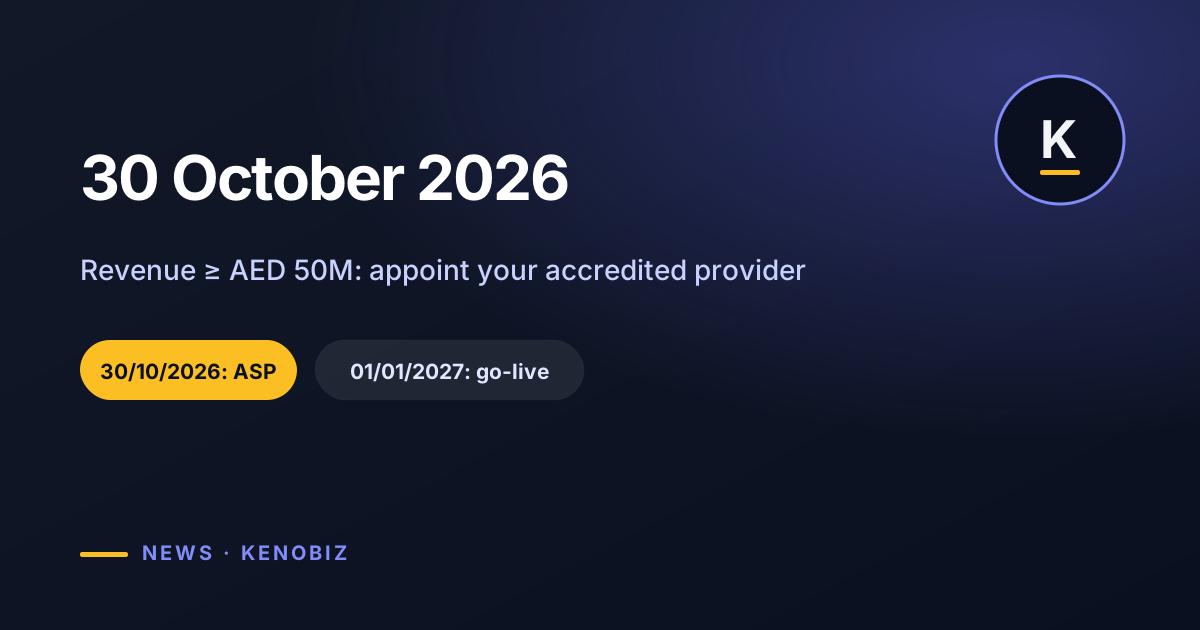
If your business generates AED 50 million or more in annual revenue, one date matters more than any other this year: 30 October 2026. It is the deadline to appoint your accredited e-invoicing provider. Here is what to do, and in which order.
What changed in May 2026
Ministerial Decisions No. 243 and 244 of 2025 set 31 July 2026 as the deadline for businesses of AED 50 million or more to appoint an accredited service provider (ASP). Ministerial Resolution No. 66 of 2026 moved it to 30 October 2026.
What did not move: e-invoicing becomes mandatory for these businesses on 1 January 2027. The extra time applies to choosing the provider, not to go-live. In practice, the extension mostly shortened the time between signing and going live.
Are you in scope?
Yes if your annual revenue is AED 50 million or more. If you are unsure about the calculation (group scope, reference year), confirm it with your tax adviser: the stakes justify the check.
Below that threshold, your deadlines are 31 March 2027 for the ASP and 1 July 2027 for go-live. Read on anyway: the same steps await you, with a little more margin.
What being late costs
Cabinet Decision No. 106 of 2025 provides for AED 5,000 per month or part of a month for failing to implement the system or appoint an accredited provider on time. After that, each e-invoice not issued or sent as required costs AED 100, capped at AED 5,000 per month. Not to mention the most concrete risk: invoices rejected by your customers, and payments delayed.
The three-week action plan
Week 1: the assessment.
- Monthly volume of invoices sent and received, share of B2B and B2G.
- Which systems produce your invoices today, and whether they can produce structured e-invoices.
- A shortlist of two or three accredited providers compatible with your software, from the Ministry of Finance's official list.
Week 2: the decision.
- Compare on the criteria that matter: ERP connector, supplier invoice reception, rejection handling, price on your real volume, reversibility. Our article on how to choose your accredited service provider details these criteria.
- Sign with your chosen provider before 30 October.
Week 3: the project kick-off.
- Data cleansing: customer and supplier TRNs, addresses, VAT categories.
- Planning of connector configuration and testing.
November and December: test before 1 January
Once the provider is appointed, you have two months to configure, test and train. And those two months include the year-end holidays and the preparation of the annual closing. Use the voluntary adoption phase, open since 1 July 2026, to send your first real e-invoices before the mandate.
What if your software cannot keep up?
If your current tool cannot produce structured e-invoices, or your invoices still come out of spreadsheets, the question is no longer just which provider to choose: you need software able to talk to it. It is the moment to consider an ERP such as Odoo, which handles accounting, UAE VAT and invoicing on one database. Our step-by-step guide with Odoo explains the approach.
In short
- ≥ AED 50M: ASP by 30 October 2026, mandatory from 1 January 2027.
- < AED 50M: ASP by 31 March 2027, mandatory from 1 July 2027.
- Start with the assessment, decide on objective criteria, then test during the voluntary phase.
If you want a quick review, our free 30-minute audit does exactly that: confirm your deadline, the state of your software and the first actions.
Information current as of 10 October 2026, provided for guidance. Official reference: UAE Ministry of Finance.
- E-invoicing
- UAE
- Compliance
- News